WFH successfully with others
WFH successfully with others
By the Roadmap+ Team
Since the lockdowns of the COVID-19 pandemic, we've learned that living and working together 24/7 can cause anything from minor household friction to the end of the closest of relationships, with even the most tolerant among us reportedly having struggled to maintain domestic harmony. Fortunately, for the majority who've powered through, some studies have found that the most common issues actually tended to stem from dissatisfaction with the home as a workplace.
A number of studies on the COVID-19 lockdown periods found around 50 percent or more workers were either working in their bedroom or sharing a workspace with others in a communal area, such as the dining table, sofa or kitchen bench. Common complaints revolved around a lack of space and privacy, not being work from home-ready, issues with workspace ergonomics (e.g. seating, temperature, lighting), and the home internet connection not being capable of handling the various demands of everyone being at home and online. Work from home (WFH) wasn't something many were prepared for, so suddenly having to accommodate that, and in some cases also having to manage school-age children learning from home or friends and relatives who were suddenly home too, in addition to the aforementioned complaints was nothing less than a challenge.
...make an effort to communicate needs and frustrations...give everyone space, quiet and privacy...
Maybe the obvious solution would have been to simply increase the home workspace and get some help around the house? Unfortunately, moving to a larger home and hiring assistants wasn't and isn't an option for most, but now that we aren't confined to our homes, part of the problem has already been resolved – lockdowns are over so it's easier to get away to somewhere more productive, whenever you feel the need. And for those of us who want – and are lucky enough – to continue WFH, these are our 8 tips for reducing conflict, maintaining a workspace conducive to concentration and privacy, retaining the benefits of WFH, and enjoying WFH as much as possible.
1. Equip your workspace
First and foremost, gather what you need to be comfortable and flexible. As workspace quality was the main problem, consider room, position, overhead lighting, backdrop for meetings, outlook, glare, and critical matters like power outlets when deciding where your primary desk or workspace will be. Consider a reshuffle of part of the lounge or dining room with your home “coworkers” (co-homeworkers?), possibly creating a shared office space or private-ish meeting room for all. If possible, your bedroom should not be your primary workspace (read here for why).
Invest in a suitably sized desk, an ergonomic chair, a chair mat to protect your floor and roll around smoothly, a footstool if you can't keep your feet firmly on the floor, a printer, stationery and spare stock, noise reduction or closed-ear headphones, bright lights that evenly cover your immediate desk area, a bookshelf or drawers for sundry items you might infrequently use each week (e.g. stapler and staples, spare printing paper, pantry snacks, book to read on breaks).
2. Plan ahead and communicate
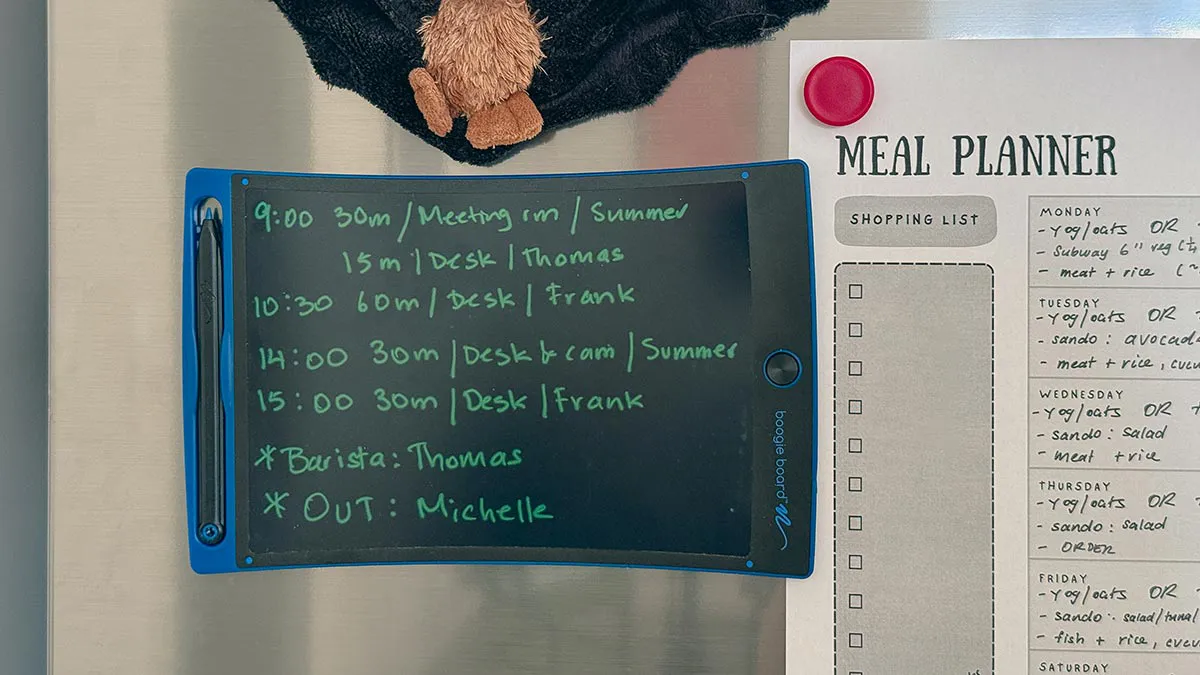
Particularly if you don't have a lot of space, communicating busy or stressful work periods and meetings that require privacy will provide an opportunity to organize in advance where everyone will be during the day and when. Jot down important scheduled calls and meeting times with initials every night on a blackboard with chalk, mirror or glass with washable markers, whiteboard or portable LCD writing/drawing board displayed prominently in a widely accessible spot (e.g. fridge, hallway or living room coffee table). Also note if you'll be away all day, especially if your primary workspace could be used by someone else for a meeting or focus session. Coordinating critical work hours with everyone ahead of time will limit disruptions and improve everyone's WFH experience.
3. Create hot deks and nooks
Designate hot desks around the home. Ideally, you won't be spending the bulk of your day there, so anything goes, the more variety, the better, and you'll increase the chances that your roommates (read: friend, partner, parent, child) are somewhere else! Stand at a high table or bench, make it feel more fun with beanbags, use balconies, patios, empty or unused garages, while outdoor furniture can act as a café or park-like experience.
At least one hot desk or nook should be quiet and private enough to be utilized as a kind of bookable meeting room, preferably with a door to close and keep out noise. If you live in an open plan home or apartment, it will be harder to find quiet spots for meetings, so consider giving up the most minimally furnished bedroom for meetings during work hours. It's a big ask of that room's resident, so sweeten the deal with a daily coffee, treat or chore.
Finally, anyone who is constantly on the phone or in meetings should position their permanent workspace away from others who are also frequently on calls or in meetings.
4. Create a home cafe
Consider the kitchen or island bench a popular coffee spot and quick desk getaway (as long as it won't be a major distraction to anyone nearby). Create a menu, make cookies, take turns being the barista, but remain flexible. Take it day-by-day, assume nothing but a self-service space, and make an effort to offer a round of coffees when you have enough time to be the barista.
You could also create a playlist of background café sounds, music or even white noise. It will feel more real and fun, plus background or white noise may improve focus or creativity in some people if you also use it as a work nook.
5. Work like you're WFO
Approach each work day like you WFO (work from the office), from the moment you get up right through to when you switch off. This includes getting up and putting on camera-friendly attire so that you don't create havoc looking for a business shirt at the last minute. It could also mean using a treadmill or taking a walk around the block before and after work to emulate going to/from work.
Prepare drinks, snacks and any items you'll need in the morning and top up at lunch or during a break to avoid being a distraction to others. Use a large reusable bottle, keep a box of tissues, use a bag packed with all your daily essentials to efficiently move from one workspace to another with little fuss. Try meal prepping lunches to reduce kitchen or food delivery commotion when others may not be free to have lunch at that time.
Socialize with your roommates as you would your colleagues by taking short breaks to have a quick chat over coffee or destress as you vent about work on a brisk walk in the sun. If you implement the home café suggested in point 4, play barista for your roommates if time permits.
6. Take breaks and move
Amongst the few cons of WFH, a lack of incidental activity and overall physical activity has repeatedly been reported in numerous studies, with few noting otherwise. Besides making a concerted effort to add physical activity to WFH days, you can increase incidental movement by standing at your desk, a high table or bench and stretching; going for a walk around the property or block when you only need to listen in on a meeting or have a 1:1 with someone, eating lunch outside or occasionally treating yourself at a local eatery, and as we discussed in point 5, walking before and after work as if you're walking to work or between public transport will surely add a significant number of steps to your day and increase what would otherwise occur through incidental activity.
Particularly useful if you're home has limited quiet space is to plan your breaks around others' important meetings during the day. If you often lose track of your breaks, use your phone alarm and aim to get urgent work finished before then to reduce the stress of someone emailing you for something while you're out or offline. And if you or a roommate is feeling stressed, take a break together outside and be other's support system.
7. Be strict and set boundaries
Set boundaries around your work, lunch and breaks time. This includes uncontrolled chatting, online shopping, visitors, being tempted to slack off due to others' quieter days, excessively helping others (with a different employer) with their work, chores or personal matters, indulging in home activities (e.g. cleaning, baking, watching Netflix in bed or on the sofa), or using social media more than you would in the office with colleagues and management about.
Sitting closely together, be it in pairs or a group, can quickly escalate an otherwise brief chat into hours of conversation. If you think the seating arrangement could lead to chats spiralling out of control and affecting productivity, try sitting back-to-back or at a minimum, out of each other's line of sight, and consciously agree to limit conversation to breaks or by first checking in with each other via a short message or text. Avoid initiating conversation with any roommate when not on a break, for that matter. The message/text first rule should also apply to a tea or coffee break proposal, lunch and finishing up work invitations.
8. Work Somewhere Else
Whether it's due to friction at home, company hybrid rules or you just have an itch to get out, working somewhere else will not only help you separate work from home, but the fresh scenery could heighten creativity, increase productivity and improve your mood, helping you to tackle tasks from a new and invigorated perspective.
Switch up your location spontaneously, but to really reap the benefits as a household, weekly scheduled days out will give everyone some respite, an opportunity to appreciate each other's company when together, and potentially put you in a better mood and reduce stress when you are at home.
When the time comes to work away from home but not WFO, there are ample workplace choices in most towns and cities. You're likely to have at least a few of those we note in this article listing 12 (12 places to work away from your desk). As it was published pre-pandemic, it doesn't include common free wi-fi and work lounges/nooks/bars in malls and public parks popping up everywhere, a table for yourself at a food court, foyers of large corporate buildings often with an internal or nearby café, museums, themed gardens (e.g. botanic, cultural), or buffet restaurants (the latter, albeit, not free, but you won't go hungry!). Most places have free wi-fi now and it's generally easy to find out ahead of time if there is a free connection by checking their social media, website, Facebook, council or community info pages, or by picking up the phone.
Summary
For the home-workplace to flourish, everyone needs to step up and make an effort to communicate their needs and frustrations, accommodate others as much as themselves, and be proactive in changing a situation before it gets out of hand. Employ as much of the steps provided above and any of your own that have worked, but remain adaptable and prepared to give everyone the space, quiet and privacy they need to continue successfully WFH with you.
References
- Australian government 'Working from home research paper', https://www.pc.gov.au/research/completed/working-from-home/working-from-home.pdf
- Bloom, N. 'How working from home works out’, https://siepr.stanford.edu/publications/policy-brief/how-working-home-works-out
- Chaudhary et al. 'Transitioning to working from home due to the COVID-19 pandemic significantly increased sedentary behavior and decreased physical activity: A meta-analysis’, https://www.mdpi.com/1660-4601/21/7/851
- Johanson, M. 'How your space shapes the way you view remote work’, https://www.bbc.com/worklife/article/20210218-how-your-space-shapes-the-way-you-view-remote-work
- John Leonard 'Why a change of scenery boosts remote work productivity and your mental health’, https://johnleonard.com/blog/why-a-change-of-scenery-boosts-remote-work-productivity-and-your-mental-health/
- Lee, JH & Lee, S 'Relationships between physical environments and creativity: A scoping review’, https://www.sciencedirect.com/science/article/pii/S1871187123000469
- Manner et al. 'Factors influencing physical activity and sedentary behaviour in contact centres during the COVID-19 pandemic and their relevance for the future of hybrid working’, https://www.pure.ed.ac.uk/ws/portalfiles/portal/477671220/MannerEtal2024PLOSOFactorsInfluencingPhysicalActivity.pdf
- de Oliveira da Silva Scaranni et al. 'Work from home and the association with sedentary behaviors, leisure-time and domestic physical activity in the ELSA-Brasil study’, https://bmcpublichealth.biomedcentral.com/articles/10.1186/s12889-023-15167-z
- Phillips, H 'Study says home working boosts exercise habits’, https://www.bbc.com/news/articles/czxdyn22dv0o
- Streeter et al. 'From bad to worse: The impact of work-from-home on sedentary behaviors and exercising’, https://longevity.stanford.edu/wp-content/uploads/2021/05/Sedentary-Brief.pdf
- Stroom et al. 'Does working from home work? That depends on the home’, https://pmc.ncbi.nlm.nih.gov/articles/PMC11305525/
- Tleuken et al. 'Effects of the residential built environment on remote work productivity and satisfaction during COVID-19 lockdowns: An analysis of workers’ perceptions’, https://pmc.ncbi.nlm.nih.gov/articles/PMC9131446/
- Young, E. 'Can listening to white noise help you focus?’, https://www.bps.org.uk/research-digest/can-listening-white-noise-help-you-focus
Category:
For updates on new tools and apps, subscribe to our newsletter. We only send these out when there's something truly exciting - we won't spam you.