Activity stocktake
Activity stocktake
By the Roadmap+ Team
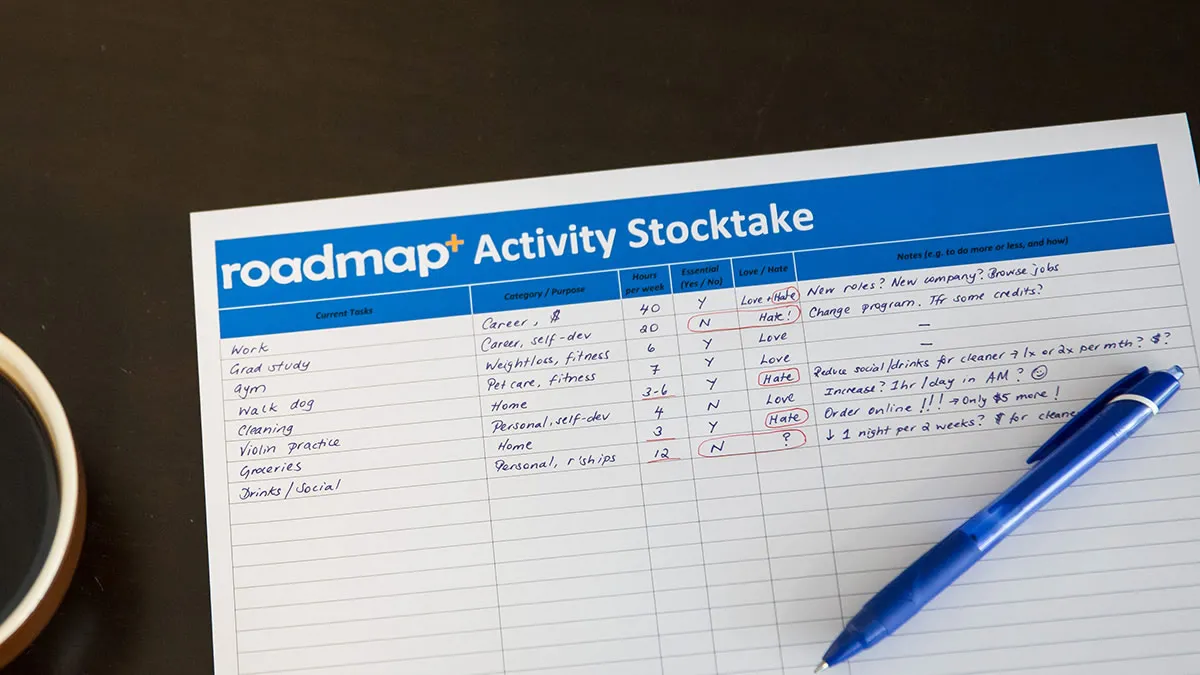
Most people struggle with time management at some point in their lives or all the time, while for others being super busy is a bit of a status symbol. Of course, it's more often than not an honest complaint reflecting a schedule or to do list that has no end – or sleep – in sight, let alone time to work on that book you've always wanted to write or spend a summer in Paris. We've introduced some basic steps to handling less appealing tasks, but there are times when you simply cannot choose a frog, a two-minute task or pay someone else to do the cleaning.
Download Activity Stocktake printable template as PDF (86KB)
Download Activity Stocktake template in Excel format (50KB)
Each issue of this magazine moves through the phases of achieving a more fulfilling and satisfying life, so to get you started before the November Goals issue, we have prepared a worksheet to help identify what's chewing up your time. Even if you're not sure of your goals, the worksheet will highlight how you spend your time and brings those non-essential tasks that you don't love to your attention, so that you can immediately limit them from being a significant time-consumer in your life.
Tasks will feel more satisfying, worth it and manageable
Here are the steps to make the Activity Stocktake worksheet work for you:
- Print the PDF or open the .xls file in Excel or an Excel-compatible application.
- In the Current Tasks column, list all the tasks you have to do. That's routine tasks (ie daily, weekly, monthly, etc), one-off tasks (eg assignments, projects, books to read) and, if you have them, goal-related tasks (eg violin practice, art class, CrossFit club search).
- In the Category / Purpose column, run through each task in the first column and think about the big picture. Where does it fit into your life right now, short-term, long-term? For example, violin practice could be categorised “Orchestra” if your goal is to one day join an orchestra. It could be to satisfy your parents, a hobby or self-development, in which case you could categorize it as 'Personal' or 'Self-development'.
- In the next column, enter the number of hours per week you spend on each task, line-by-line. Estimate or keep track in a diary this week. For tasks that are goal-related and possibly not yet started, mark it with an honest zero.
- The Essential column might be tricky and may depend on your priorities or phase in life. For example, if you're still in school, violin practice might be compulsory for reasons beyond your control, so you might not want to mark it No, for not essential. However, depending on reasons beyond your control, if you don't feel strongly about something, it's a good idea to be honest about each task as it will help with the final step in this process. The same goes for having chosen the wrong graduate program – is it absolutely essential to continue? Maybe not. As such, there might be something you can do, like transferring credits to something more relevant or something you feel more passionately about.
- Love / Hate is self-explanatory and straightforward. How do you really feel about the task?
- Highlight or circle the Nos in the Essential column. Highlight or circle the Hates in the Love / Hate column.
- This is the final and most crucial step of the Activity Stocktake. Use the Notes column to write your suggestions or actions.
- Where you have a No / Love combination, the task is obviously something you enjoy doing and probably do so voluntarily of your own accord. Think about increasing the hours or frequency of this task, but at least ensure you keep it up!
- A Yes / Love combination is possibly something you feel you need to do and fortunately for you, you do enjoy. It could be exercise, work or study. It may not be necessary to increase hours or frequency of this task depending on what it is.
- No / Hate combinations should be a no-brainer. These tasks should be eliminated right away, where possible. As described earlier, these tasks may still be a task for various reasons, such as being in an expensive study program and not being able or willing to cut losses to date. For example, if it's the dreaded violin practice, you could propose swapping it for guitar, dance or martial arts. In these instances, think hard about what you could do to improve the task or situation somehow. Ask friends, family, professionals or a Google search for ideas. Why this is still a task may mean there are some serious changes or adjustments to be made.
- Yes / Hate combinations are usually tasks that need some tweaking or outside the box thinking. It might be a job you don't like – spend an hour each day sending out CVs and feelers. Doing the groceries – create a meal plan and only buy what you need, order online and have it delivered, meal share or find healthy options to go. These must-do tasks might require creative solutions, but oftentimes there is a way to make things more doable.
Assuming you get up at 7am and sleep at 10pm, that's 105 hours a week to make stuff happen. It's not a lot of time to change the world, but if you periodically take the time to analyse where those hours go and take the necessary action to fill them more wisely, tasks will feel more satisfying, worth it and manageable.
Category:
For updates on new tools and apps, subscribe to our newsletter. We only send these out when there's something truly exciting - we won't spam you.